
Hospital Operations
Agentic AI: A New Vision for Hospital Operations (Speaker: Ms. Manini Puranik, Founder Ekayya)
Section titled “Agentic AI: A New Vision for Hospital Operations (Speaker: Ms. Manini Puranik, Founder Ekayya)”One of the most forward-looking themes of the session was the definition of Agentic AI—a concept championed by Ms. Manini Puranik—and its role in fundamentally transforming how hospital systems work.
Current Systems vs. The Agentic Shift
Section titled “Current Systems vs. The Agentic Shift”Traditional hospital systems (HIS/EMRs) are historically static gateways. They require high manual effort to “input” data and often act as digital filing cabinets that respond only to direct human commands.
In contrast, Agentic AI represents a shift toward:
- Autonomy: Systems that don’t just store data but take proactive actions based on clinical goals.
- Real-Time Orchestration: Moving from periodic “data entry” to a continuous flow of assistance that moves with the surgical or clinical team.
- Why it’s Different: Unlike previous AI generations that were purely analytical (identifying patterns), Agentic AI is operational—it can navigate workflows, coordinate between departments, and assist in real-time decision-making.
The Three Pillars of Agentic Operations
Section titled “The Three Pillars of Agentic Operations”The vision for the future hospital is built on three core operational principles:
- Intelligent: The system provides more than just data storage; it offers real-time insights and automated orchestration of the patient journey.
- Adaptive: The technology is designed to thrive in the dynamic, high-pressure environment of a hospital. It adjusts to emergencies, resource shifts, and changing clinical priorities in real-time.
- Human-Centric: Most importantly, the technology is built around the humans who use it. It aims to reduce the “operational load” on clinicians, allowing them to focus on the patient rather than the screen.
Specialized Systems: LIMS & AI Radiology
Section titled “Specialized Systems: LIMS & AI Radiology”The digitization of clinical ecosystems is completed by specialized, high-fidelity systems.
- LIMS (Laboratory Information Management): These systems manage the entire lifecycle of a medical laboratory—from sample tracking and testing to processing and reporting—ensuring end-to-end data integrity.
- AI in Radiology (PACS/RIS): The radiology field is highly mature in its use of AI. Images captured via PACS (Picture Archiving and Communication System) are now routinely interpreted by AI algorithms to generate high-accuracy preliminary reports, freeing up radiologists for more complex cases.
National TB Elimination Program: Breaking Taboos with AI
Section titled “National TB Elimination Program: Breaking Taboos with AI”A powerful application of AI discussed by Dr. Richa Y Singh is its role in the National Tuberculosis Elimination Program (NTEP), where technology is being used to address both clinical and social challenges.
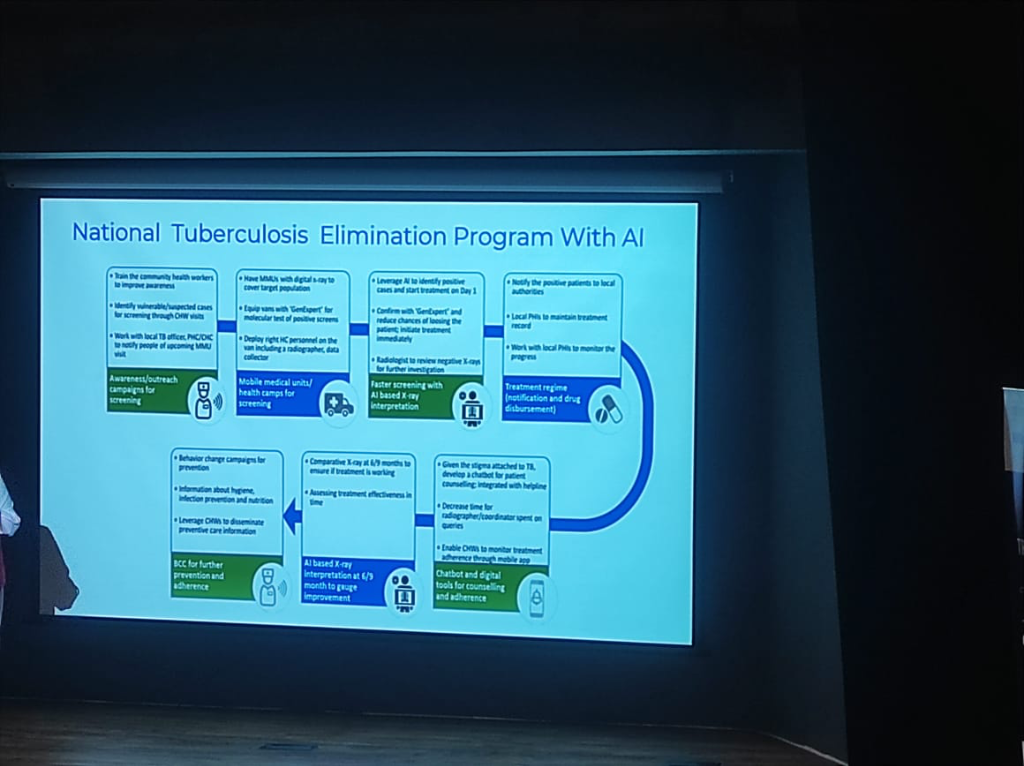 Figure: The AI-driven workflow for national TB elimination, from mobile screening to Day 1 treatment.
- AI-Driven Workflow:
- Mobile Medical Units (MMUs): Vans equipped with digital X-rays and AI-based X-ray interpretation software for faster screening.
- Day 1 Treatment: AI identified positive cases are confirmed via GenExpert molecular tests, aiming for treatment initiation on the very first day.
- Continuous Oversight: AI is used to review negative X-rays for further investigation and to gauge improvement via comparative X-rays at 6/9 months.
- Breaking the Stigma: The Trilingual Chatbot:
- The Taboo Challenge: TB carries a significant social stigma in many communities, often leading to delayed treatment.
- The AI Solution: A trilingual chatbot was developed for patient counseling and adherence.
- Outcome: Patients were found to be significantly less hesitant to interact with a bot than with a human for TB queries, bypassing the taboo and ensuring better engagement.
- Support Tools: The workflow incorporates Differential Diagnosis for lung conditions, Doc Scanners for digital records, and BCC (Behavior Change Communication) campaigns to improve awareness.