Medical Informatics
🌍 Earth — Realities Medical Informatics & Clinician Adoption.
Medical Informatics: The Bridge Between Worlds
Section titled “Medical Informatics: The Bridge Between Worlds”A recurring theme during the event was the unique role of Medical Informatics. Colonel (Dr) Kalyani Addya (KCDH) described it simply but powerfully:
“Medical Informatics is the bridge between doctors and engineers.”
In the current landscape, medical professionals and technical experts often speak “different languages.” There is a fundamental language mismatch where the data scientist’s technical abstractions must be reconciled with the clinician’s grounded experience. KCDH provides the common ground where engineering expertise (Data Science, AI) meets clinical realities (Patient outcomes, diagnosis).
The Academic Bridge: Research-Driven Foundations (Speaker: Prof. Kshitij Jadhav)
Section titled “The Academic Bridge: Research-Driven Foundations (Speaker: Prof. Kshitij Jadhav)”Beyond technical standards, the 2026 roadmap is anchored in a research-driven foundation that bridges the gap between clinical needs and data science:
- The Collaboration Paradigm: AI development must be a Clinical-Data Scientist action plan. Clinicians shouldn’t just be “providers of data” but active co-pilots in defining the “Why” and the “What” of clinical AI.
- Translating Signal to Action: Research at KCDH focuses on translating “noisy” data—whether from EHRs or wearables—into high-fidelity actionable insights that clinicians can trust.
The Mathematical Foundation (Speaker: Prof. Saket Choudhary)
Section titled “The Mathematical Foundation (Speaker: Prof. Saket Choudhary)”For data-driven healthcare to be trustworthy, it must be grounded in mathematical rigor.
- Statistics as the Grammar of AI: A core technical tenet is that statistics forms the fundamental grammar for any medical AI. Without statistical rigor, models cannot reliably address the stochastic (random) nature of biological and clinical data.
- Stochastic Realities: Medical informatics must account for the inherent “noise” in human biology. Trust is built not just on high-accuracy results, but on understanding the underlying probability and variability of clinical outcomes.
Open Source Tools for Data Science
Section titled “Open Source Tools for Data Science”To enable this mathematical rigor at scale, the Saket Lab has developed a suite of open-source tools specifically designed for Indian clinical and biological data:
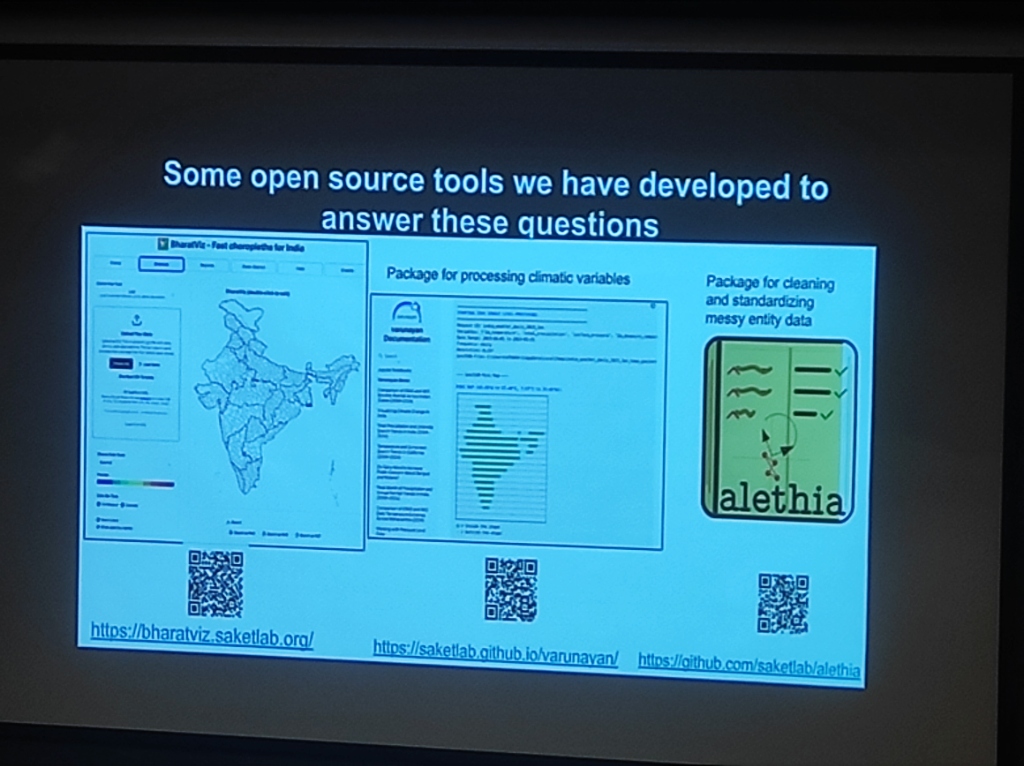 Figure: Open-source packages from Saket Lab—bridging the gap between messy entity data and standardized clinical analysis.
- BharatViz: A fast choropleth mapping tool for India, essential for epidemiological visualization and public health monitoring. (bharatviz.saketlab.org)
- Varunayan: A specialized package for processing climatic and environmental variables, enabling research into the environmental determinants of health. (saketlab.github.io/varunayan)
- Alethia: A powerful engine for cleaning and standardizing messy entity data, providing the “syntactic glue” needed before advanced clinical modeling can begin. (github.com/saketlab/alethia)
The Heterogeneity Challenge
Section titled “The Heterogeneity Challenge”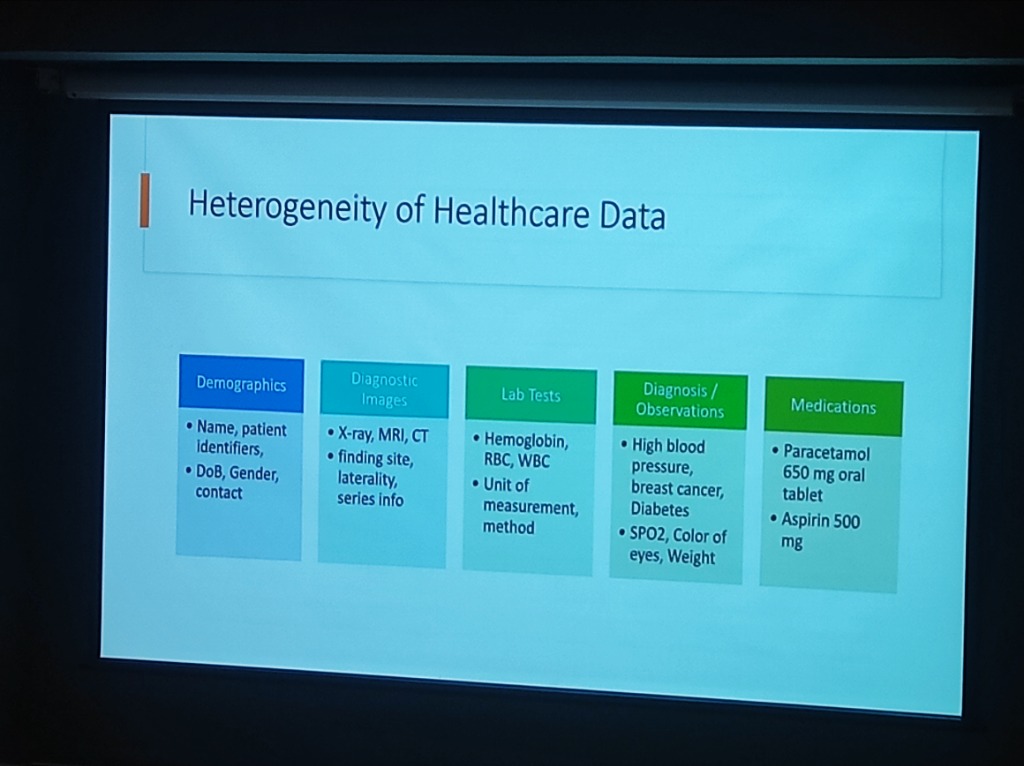 Figure: The five core dimensions of healthcare data heterogeneity—ranging from structured demographics to variable-fidelity diagnostic images and medications.
To bridge these worlds,informatics must handle the diverse spectrum of healthcare data:
- Demographics: Identifiers, contacts, and temporal data (DoB).
- Diagnostic Images: Multidimensional output from X-Ray, MRI, and CT (including laterality and modality).
- Lab Tests: Quantitative and qualitative findings with varied units and methods.
- Diagnosis & Observations: Clinical findings (SPO2, BP) and disease states.
- Medications: Granular dosing and administrative details (e.g., Paracetamol 650mg).