
Privacy Security
Privacy: An Ethical & Fiduciary Foundation
Section titled “Privacy: An Ethical & Fiduciary Foundation”DPDP: Substantiating Medical Values
Section titled “DPDP: Substantiating Medical Values”The Digital Personal Data Protection (DPDP) Act, 2023 should not be viewed as “reinventing the wheel.” Instead, it is a regulatory framework that substantiates existing medical ethics with a better, more robust legal structure. It codifies the principles of confidentiality and no-harm that have always been the bedrock of healthcare.
The digitization of healthcare in India is governed by this robust legal and ethical framework ensuring patient privacy and data security.
Regulatory Landscape
Section titled “Regulatory Landscape”Medical data is a global asset requiring adherence to rigorous regulatory frameworks:
- DPDP Act 2023 (India): The definitive, compulsory national legislation for data handling in India, mandating strict consent and introducing unique rights and heavy penalty liabilities. The rules are expected to be fully enacted by April 2026.
- NABH (India): National Accreditation Board for Hospitals & Healthcare Providers standards for operational and data quality, now featuring a Progressive Maturity Framework for digital health.
- GDPR (EU): The General Data Protection Regulation, providing stringent privacy requirements that served as a partial model for the DPDP Act.
- HIPAA (USA): While often perceived as the healthcare “gold standard,” HIPAA compliance does not automatically satisfy local DPDP mandates. Indian hospitals must cater to specific local nuances and rights not covered by US legislation.
Security & Compliance: The Global Mandate
Section titled “Security & Compliance: The Global Mandate”The AIIMS hacking case serves as a stark reminder that simple firewalls are no longer enough. Security must be multi-layered, compliant with global standards, and rooted in the principle of Security by Design—where protection is an architectural requirement, not an afterthought. Governance now mandates a “Privacy-First” approach to how data is collected, processed, and shared.
The HDMP Trigger
Section titled “The HDMP Trigger”Once a hospital volunteers for the ABDM ecosystem, it automatically triggers the Health Data Management Policy (HDMP)—a sectoral regulation that mandates:
- ABDM-Certified Tools: Hospitals are increasingly mandated to rely on ABDM-certified tools (EMRs, LIMS, Health Lockers) that have been vetted for these sectoral security standards.
- Strict Compliance: ABDM, in collaboration with NRCeS, has mandated HL7 FHIR R4 as the only acceptable standard for data exchange.
Security & Compliance: Global Standards
Section titled “Security & Compliance: Global Standards”Security is not just a policy; it is built on a foundation of rigorous international standards that ensure Resilience and Trust:
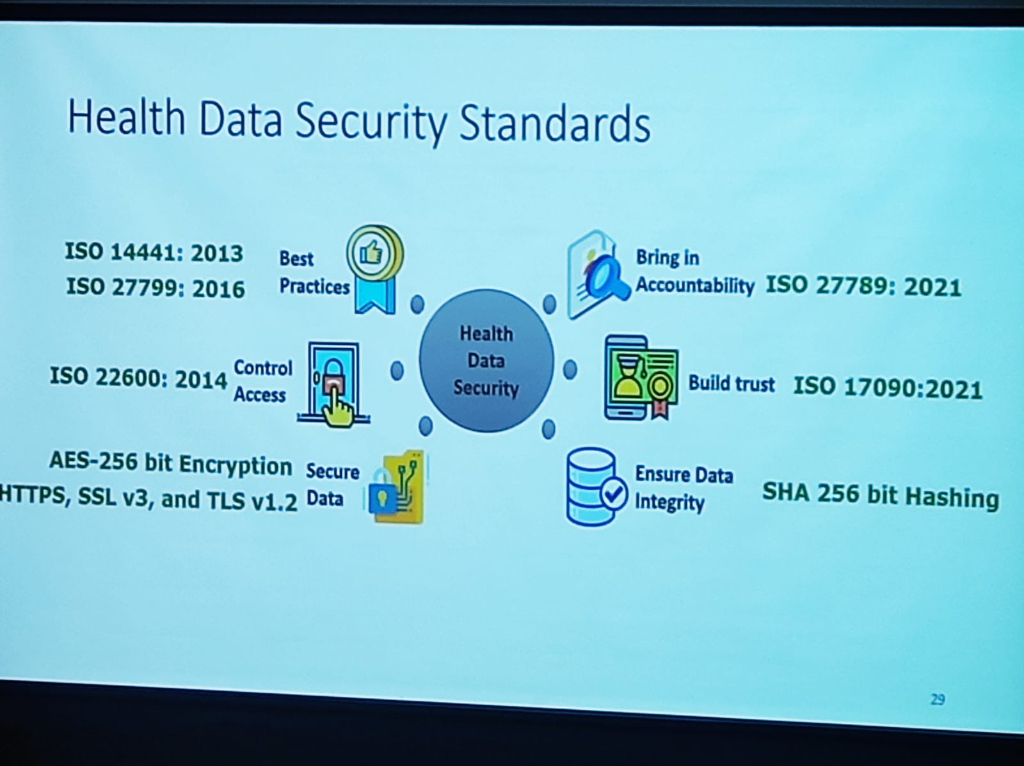 Figure: The technical foundation of Health Data Security—integrating ISO standards, encryption, and hashing protocols.
- Robust Frameworks: Adherence to ISO 27001, 14441, 27799, 22600, 27789, and 17090 provides the global benchmark for health data security.
- Technical Safeguards: Implementing AES-256 bit Encryption for data on the wire and SHA-256 bit Hashing to ensure data integrity.
- Granular Security Policies: True security extends to human behavior. Institutions must enforce policies for Remote Work (secure protocols) and Clear Desk & Clear Screen (mandatory system locking) to prevent accidental data exposure.
Sectoral Governance & Ethical Foundations
Section titled “Sectoral Governance & Ethical Foundations”Beyond national legislation, clinical data governance is bolstered by a network of sectoral policies and ethical guidelines:
- IMC Regulations 2002: Directs the maintenance of medical records for specific retention timelines and mandates the computerization of records for quick and accurate retrieval.
- National Ethical Guidelines (Human Research): Establishes policies for data capture, acquisition, sharing, and ownership, emphasizing the role of Ethics Committees in safeguarding participant privacy.
- ART Act 2021: Specifically mandates that assisted reproductive technology clinics and banks protect all confidential information and maintain accurate, secure records.
- ICMR Lab Guidelines 2021: Defines rigorous standards for Good Clinical Laboratory Practices, focusing on multi-dimensional security (Hardware, Network, Application, Personnel) and mandatory Disaster Recovery planning.
Survey & Clinical Trial: Large-Scale Data Governance
Section titled “Survey & Clinical Trial: Large-Scale Data Governance”Hospitals often generate and share massive datasets related to Health Surveys and Clinical Trials. These “large-set” exchanges present unique architectural and security challenges:
Pseudonymization vs. Anonymization
Section titled “Pseudonymization vs. Anonymization”A critical distinction for large-scale data governance:
- Pseudonymization: A technical measure where personal identifiers are replaced by codes. This process is reversible (with a key) and the data is still classified as Personal Data under DPDP.
- Anonymization: A process that irreversibly removes personal identifiers, ensuring the data cannot be traced back to an individual. Anonymized data is generally exempt from certain DPDP processing restrictions.
Mandatory Protocols
Section titled “Mandatory Protocols”- Avoid Aggregation Fail: Large datasets are frequently shared in their raw, granular form without proper aggregation, making it easier to re-identify individuals.
- Rigorous Standards: For research data to be safe, it must undergo strict pseudonymization or anonymization protocols, enabling population health analytics without compromising participant privacy.
Implementing Technical Measures (Speaker: Ms. Bagmisikha Puhan)
Section titled “Implementing Technical Measures (Speaker: Ms. Bagmisikha Puhan)”To counter growing clinical vulnerabilities and maintain DPDP compliance, institutions must move from theoretical security to a rigorous technical implementation roadmap:
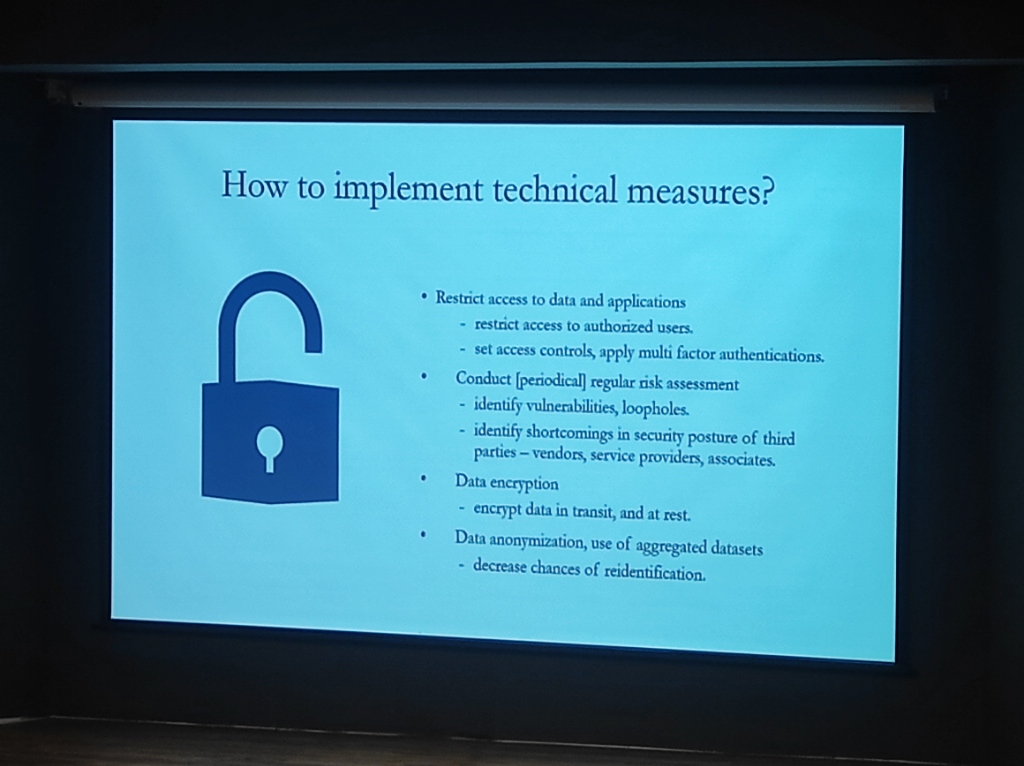 Figure: The technical implementation roadmap for DPDP compliance—focusing on access, risk, encryption, and anonymization.
- Restrict Access & Multi-Factor Authentication (MFA): Access must be strictly limited to authorized users only. Implementing Multi-Factor Authentication (MFA) across all applications is non-negotiable for securing clinical entry points.
- Periodical Risk Assessments: Security is dynamic. Hospitals must conduct regular risk assessments to identify technical vulnerabilities, internal loops, and the security posture of third-party vendors and associates.
- Data Encryption at Scale: Comprehensive Data Encryption must be enforced throughout the information lifecycle—securing data both In Transit (across networks) and At Rest (on storage servers).
- Anonymization & Aggregation: To further mitigate re-identification risks, hospitals should utilize aggregated datasets which significantly decrease the chances of a specific individual being pinpointed from a larger data set.
Research & Statistical Exemptions (Speaker: Ms. Bagmisikha Puhan)
Section titled “Research & Statistical Exemptions (Speaker: Ms. Bagmisikha Puhan)”While the DPDP Act 2023 provides certain exemptions for Research, Archiving, and Statistical purposes, these activities must still adhere to rigorous quality standards to ensure participant safety.
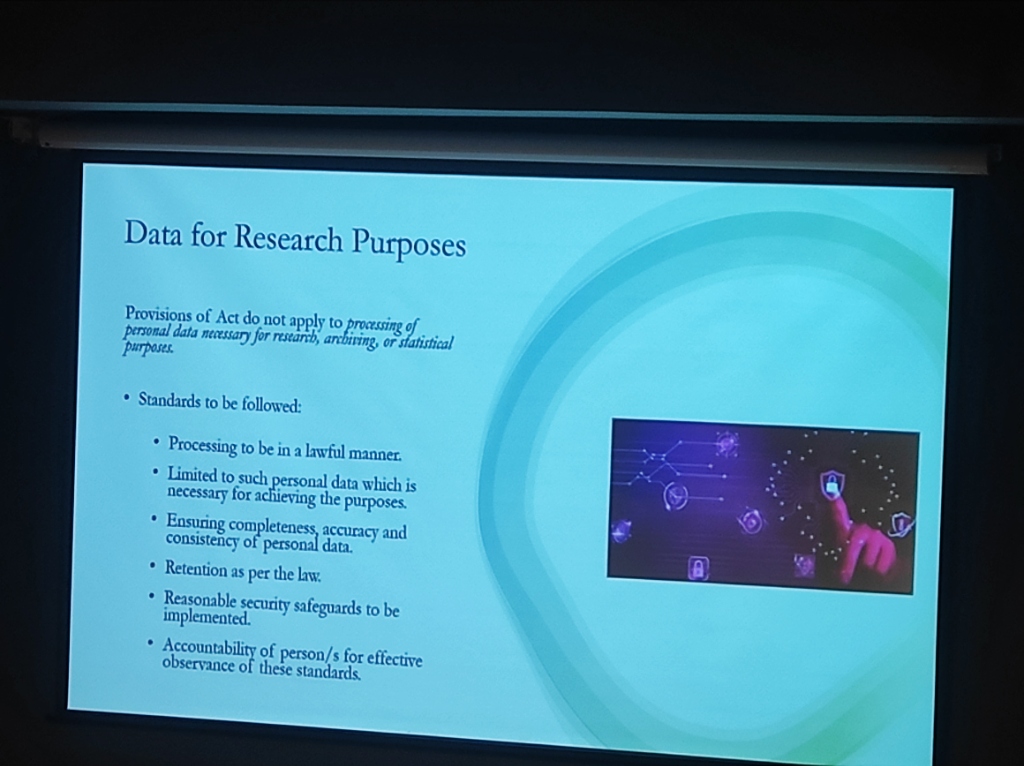 Figure: Standards for processing personal data for research, archiving, and statistical purposes.
- Lawful Manner: All processing must be conducted through established legal and ethical frameworks (e.g., ICMR, Ethics Committees).
- Data Minimization (Necessity): Processing must be limited ONLY to such personal data which is strictly necessary for achieving the research purposes.
- Completeness & Accuracy: Researchers are responsible for ensuring the completeness, accuracy, and consistency of the clinical data they handle.
- Reasonable Security Safeguards: Even exempt research data must be protected with modern security measures to prevent leakages or unauthorized access.
- Accountability: Every person or institution handling research data remains accountable for the effective observance of these privacy standards.