
Business Strategy
National Strategy: Entrepreneurship & ABDM (Dr. Thanga Prabhu)
Section titled “National Strategy: Entrepreneurship & ABDM (Dr. Thanga Prabhu)”A landmark moment at KCDH, IIT Bombay was the session led by Dr. Thanga Prabhu (MBBS, Emergency Medicine Specialist, former CMIO for Apollo Hospitals). With over a decade of experience in Emergency Medicine across Abu Dhabi and the UK, Dr. Prabhu brought a global clinician’s perspective to the inauguration of the pan-India awareness campaign for the Ayushman Bharat Digital Mission (ABDM).
- The Bahubali Metaphor: Dr. Prabhu opened with the image of the GSLV Mark III, popularly known as “Bahubali”—India’s heaviest rocket. This was not just a tribute to space exploration, but a metaphor for India’s massive technical capability. ABDM is envisioned as a similar “moonshot” for healthcare.
- Make in India: Engineering Self-Reliance: A core message was the shift toward absolute self-reliance. India no longer needs to import digital health infrastructure. Just as the country built the Param Supercomputer when denied foreign technology, it is now building its own health-tech ecosystem. India is now the “Manufacturing and Engineering Capital” for the world.
- The Trust Deficit: A critical “trust deficit” currently faces the private healthcare ecosystem. When patients visit private facilities today, there is often uncertainty about whether a procedure is for the patient’s benefit or the hospital’s bottom line.
- The Rethink of Healthcare: ABDM represents a complete rethink of the ecosystem. Just as the government took responsibility for education and healthcare through institutions like IIT and AIIMS, it is now building the digital infrastructure to restore trust and transparency.
Business Considerations in Digital Transformation (Dr. Richa Singh)
Section titled “Business Considerations in Digital Transformation (Dr. Richa Singh)”Following the strategic session on entrepreneurship, Dr. Richa Singh (Program Director, KCDH) presented a foundational framework centered on Design Thinking, Market Trends, and Business Economics for healthcare transformation.
Industry Trends 2021-2030: The Digital Explosion (Speaker: Dr. Richa Y Singh)
Section titled “Industry Trends 2021-2030: The Digital Explosion (Speaker: Dr. Richa Y Singh)”Dr. Richa Singh (KCDH) provided a forward-looking roadmap for the Indian healthcare market, projecting a decade of unprecedented growth.
Dr. Richa Singh outlined a foundational framework for healthcare product development in the Indian context, centered on First Principles.
Design Thinking: Innovation for India
Section titled “Design Thinking: Innovation for India”- Go by First Principles: Success starts with identifying exactly what problem you want to solve and who the primary and secondary stakeholders (clinicians, patients, administrators) are.
- Tailor to the Market: Products must be specifically adapted for the segment they intend to serve:
- Sector Specific: Different strategies for Public vs. Private sectors.
- Region Specific: Accounting for Urban vs. Rural needs, or specific city/state dynamics.
- The India Vectors: Direct integration of native Languages and the ABHA/ABDM identity stack is no longer optional.
- Low Level Infrastructure: Designing portable products that function reliably in Tier 2/3 cities.
- Low Operational Requirement: Minimizing the training burden on the healthcare workforce.
- Early-Stage Scalability: Ensuring the product architecture can scale from Day 1.
- Cost Differentiation: Achieving high quality at significantly lower prices is the benchmark for Indian innovation.
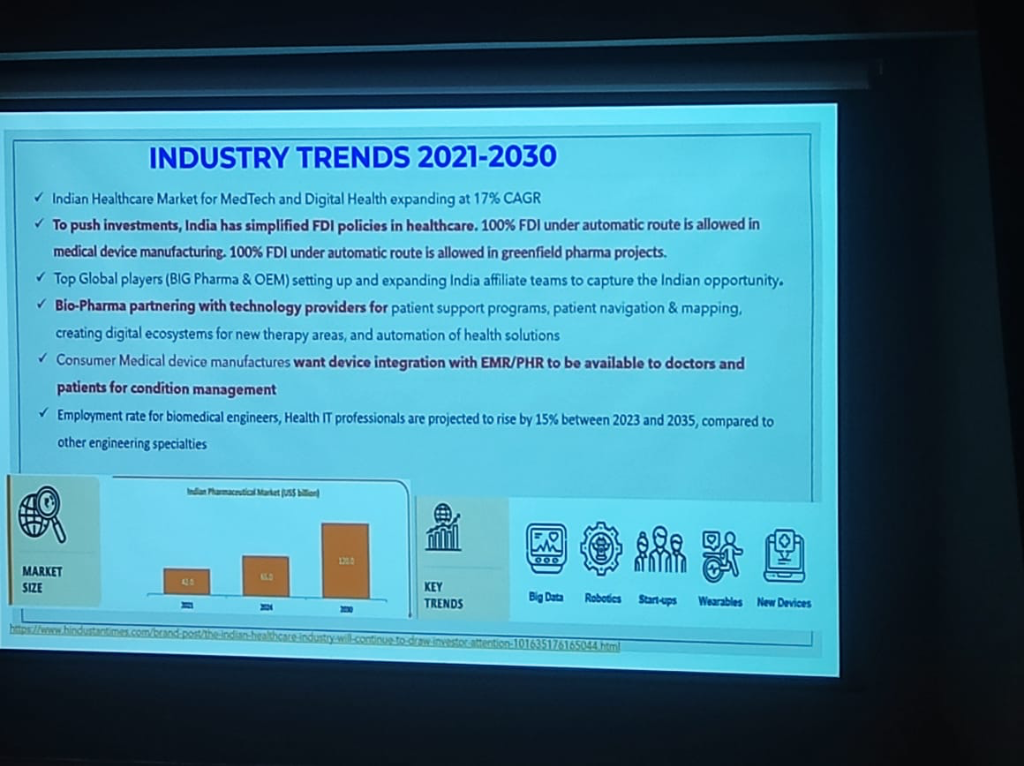 Figure: Key trends shaping the Indian healthcare landscape through 2030.
- 17% CAGR Growth: The market for MedTech and Digital Health is expanding at a robust 17% compound annual growth rate.
- Investment Simplification: India has simplified FDI policies, allowing 100% FDI under the automatic route for medical device manufacturing and greenfield pharma projects.
- Global Affiliate Expansion: Top global players (BIG Pharma & OEMs) are expanding their India-based teams to capture this regional opportunity.
- Tech-Pharma Partnerships: Bio-Pharma is increasingly partnering with technology providers for patient support programs, navigation, and therapy-area automation.
- The Talent Surge: Employment for biomedical engineers and Health IT professionals is projected to rise by 15% (2023-2035), outpacing most other engineering specialties.
The Reality of Gaps: Infrastructure & Human Capital
Section titled “The Reality of Gaps: Infrastructure & Human Capital”Despite the growth, the session highlighted the sheer scale of the challenges remaining in the Indian ecosystem.
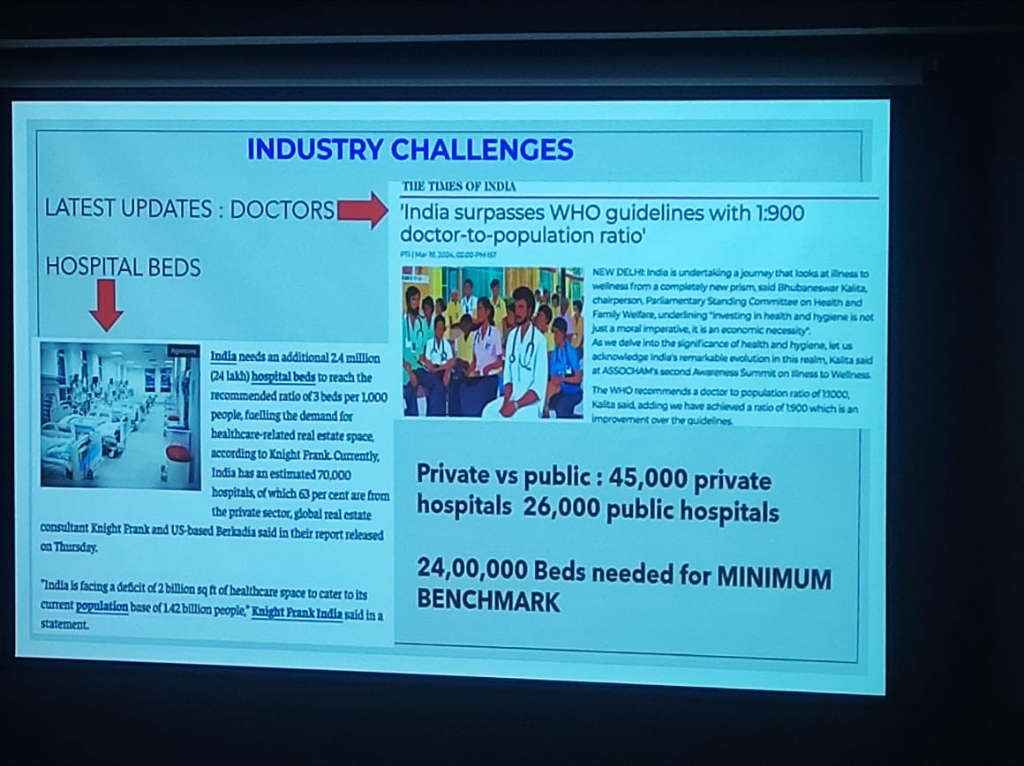 Figure: The infrastructure and human capital gaps in Indian healthcare.
- The Bed Deficit: India needs an additional 2.4 million (24 lakh) hospital beds to reach the recommended ratio of 3 beds per 1,000 people.
- Doctor Ratios: India has recently surpassed the WHO guideline of 1:1,000 with a 1:900 doctor-to-population ratio, a significant milestone, though distribution remains a challenge.
- Sector Split: The landscape is dominated by 45,000 private hospitals vs. 26,000 public hospitals. Currently, the public sector leads in complex ABHA linkage, creating a “digital maturity gap” that requires strategic alignment between DMHO licensing “sticks” and operational “carrots.”
Business Thinking: The Value Creation Shift
Section titled “Business Thinking: The Value Creation Shift”A profound takeaway from Dr. Richa Singh’s session was that Digital Transformation is not an IT project. It is an organizational, financial, and cultural shift aimed at Value Creation.
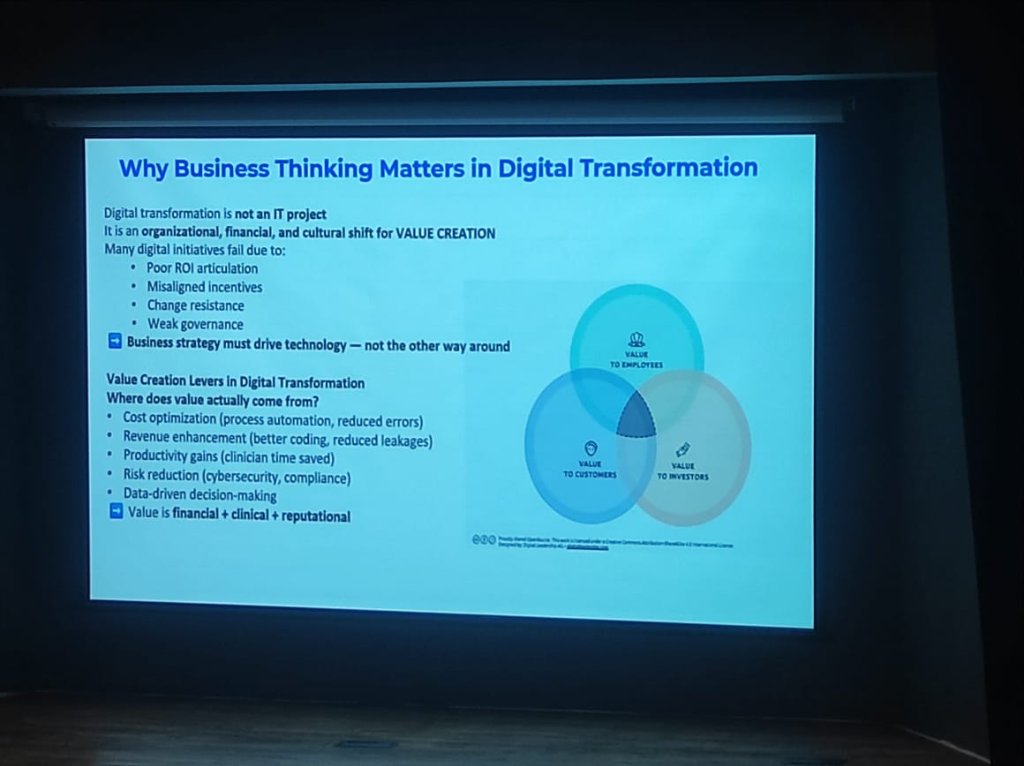 Figure: The value creation levers in digital transformation, bridging employees, customers, and investors (Source: Dr. Richa Singh).
- Why Initiatives Fail: Many digital projects falter because of poor ROI articulation, misaligned incentives, change resistance, or weak governance.
- Value Creation Levers: True value in digital health comes from:
- Cost Optimization: Process automation and reduced clinical errors.
- Revenue Enhancement: Better coding and reduced leakages.
- Productivity Gains: Saving precious clinician time.
- Risk Reduction: Ensuring cybersecurity and regulatory compliance.
- The Value Triad: Value must be measured across three dimensions: Financial, Clinical, and Reputational.
Corporate Healthcare Dynamics
Section titled “Corporate Healthcare Dynamics”The private sector in India is evolving from traditional “hospitals” toward a model of “Hospitality in Hospitals”, focusing on premium patient experience and standardized services.
- Growth & M&A: The sector is seeing aggressive expansion and consolidation, with revenues expected to grow by 12-14% in FY2026, driven by high occupancy and rising ARPOB/ARPP (Average Revenue Per Occupied Bed/Patient).
- The Telemedicine Behavior Shift: Post-COVID, there has been a fundamental behavioral shift. The “remote culture” has moved Telemedicine from a backup option to a standard “value-added service.” It is now an integral part of the patient experience and a key revenue engine.
- Revenue Engines: The sector is pivoting toward high-specialty services (Cardiology, Neurology, Oncology) and adopting high-tech drivers like Robotic Surgery and AI Diagnostics to maintain profitability and efficiency.
- Electronic Health Records: Integration with ABDM is becoming a standard requirement for private business enterprises to maintain brand recognition and operational parity.
The Private Sector Paradox: Implementation Friction
Section titled “The Private Sector Paradox: Implementation Friction”While the public sector shows aggressive adoption, private hospitals face unique Implementation Frictions:
- Licensing & Compliance (DMHO): Private hospitals often navigate a complex regulatory landscape, where digital adoption is increasingly linked to DMHO Licensing and other state-level compliance “sticks.”
- The Mandate Gap: Unlike government-led institutions, private hospitals must balance the high cost of digital transformation with operational profitability, often leading to a slower adoption curve unless mandated by national insurance schemes or regulatory requirements.
- Strategic Concentrate: As a result, the most robust “advanced” implementations are currently concentrated in large public sector institutions, creating a “digital maturity gap” that the next phase of the mission aims to close.
The Document Spectrum
Section titled “The Document Spectrum”Dr. Prabhu highlighted the diverse array of complex clinical documents that require digitization to build a true longitudinal history:
- Routine Care: Outpatient/Inpatient EMRs, Discharge and Clinic Summaries, and Consent Management.
- Acute Care: A&E Case Sheets, ICU Flowsheets, and OT Anaesthesia documentation.
- Certifications: Death, Disability, and Medical Certificates.
Home Healthcare: The Next Frontier
Section titled “Home Healthcare: The Next Frontier”A significant shift highlighted by Dr. Prabhu is the transition from hospital-centric to Home-Centric Care.
- Delivering Care at Home: Technology now enables the management of long-term conditions (Diabetes, Hypertension) and post-acute recovery in the patient’s home.
- Palliative & Mental Health: Palliative and end-of-life care, traditionally restricted to hospitals or nursing homes, can now be managed more humanely at home. Similarly, Mental Health services are being successfully delivered remotely.
- Connected Ambulances: By utilizing MIoT (Medical Internet of Things), ambulances are being transformed into “field clinical delivery” units, allowing for life-saving interventions before the patient even reaches the hospital.
The Elderly Opportunity
Section titled “The Elderly Opportunity”Dr. Prabhu identified Elderly Care as the “next big opportunity” for the next 50 years—a sector that is currently neglected but holds massive potential for digital innovation.
Digital Disruption: Redefining Drug Discovery
Section titled “Digital Disruption: Redefining Drug Discovery”Dr. Prabhu detailed how the digitization of health data is fundamentally disrupting the multi-decade drug discovery lifecycle.
- Shrinking the 10-Year Window: Traditionally, bringing a drug to market is a 10-year journey. Through Bioinformatics and advanced data management, this window is being significantly compressed.
Global Leadership
Section titled “Global Leadership”Dr. Prabhu noted that the world’s best companies are now run by Indians. This is the fruit of 30-40 years of deep investment in Education, Medicine, and Engineering.
- Global Leadership: This investment is now yielding fruit across all fields—Pure Science, Engineering, and Medicine—positioning India not just as a consumer of digital health, but as a global leader in its innovation and deployment.